
Yes! You can use AI to fill out Judicial Council of California Form CIV-050, Statement of Damages (Personal Injury or Wrongful Death)
Don't type 94 fields by hand. Tell our AI about yourself, or upload a document you already have, and it fills every field in seconds. You check it, then download, print or sign.
The AI does the filling. You just check it.
No typing into boxes, nothing to install.
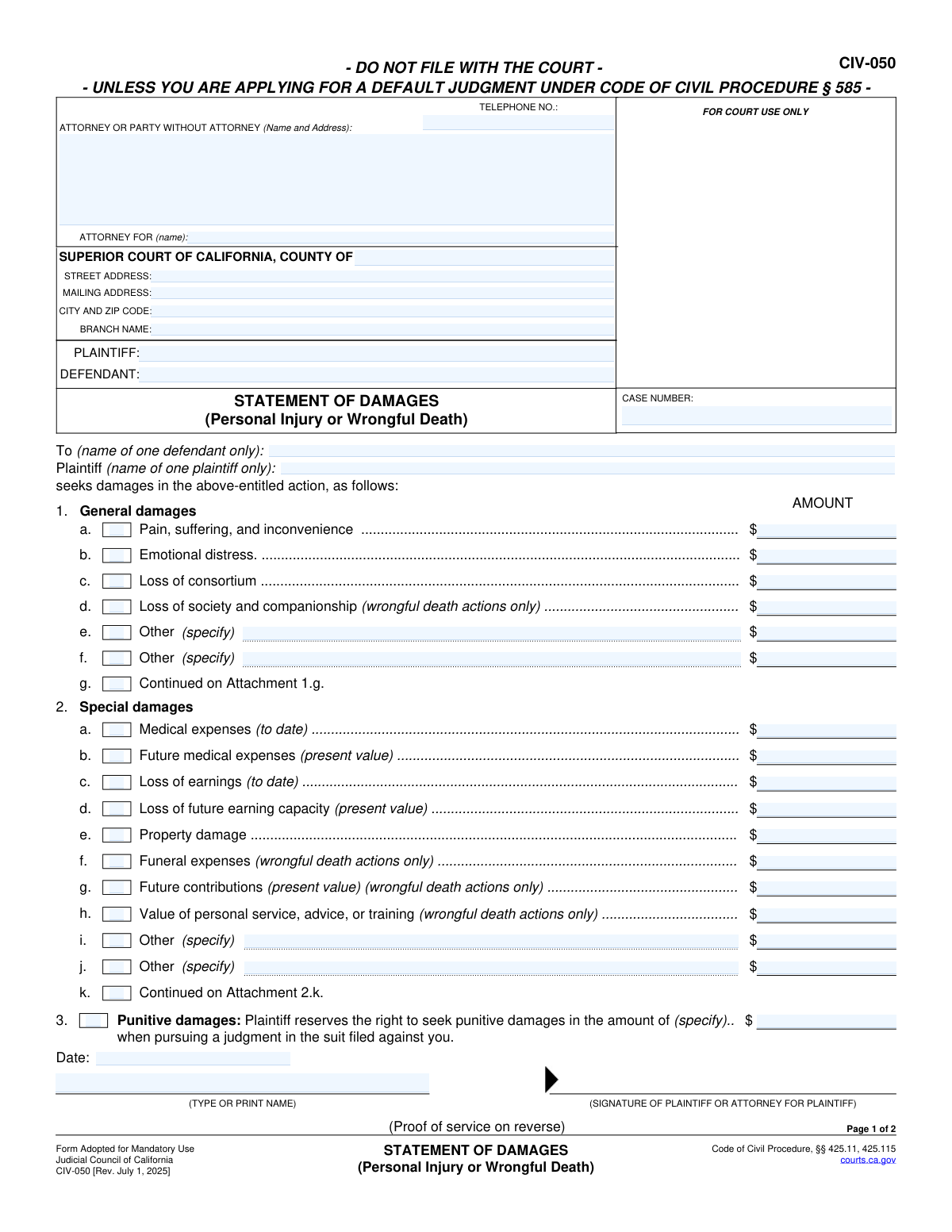
What this form asks for
The AI fills all of it, from your answers or your documents.
The AI checks your answers before you download
14 checks built for this form, so a wrong date or a missing answer is caught before anyone else sees it.
This check ensures that the 'CASE NUMBER' entered on Page 1 is identical to the 'CASE NUMBER' entered in the header of Page 2 (Proof of Service). Maintaining consistency is crucial for ensuring all pages are correctly associated with the same legal case file. A mismatch could lead to filing errors or the rejection of the document.
Validates that all monetary amount fields in sections 1 (General Damages), 2 (Special Damages), and 3 (Punitive Damages) contain only valid numeric currency values. This prevents data entry errors, such as including text or symbols, which would cause miscalculations and processing failures. The validation should allow for numbers, commas, and a decimal point.
This rule checks that if the 'Other' checkbox is selected in the General Damages section (1.e or 1.f) or the Special Damages section (2.i or 2.j), the corresponding 'specify' text field is not empty. This is important for clarity and legal sufficiency, as the nature of the 'other' damages must be explicitly stated. Failure to specify renders the claim for that amount ambiguous and potentially invalid.
Verifies that the fields 'To (name of one defendant only)' and 'Plaintiff (name of one plaintiff only)' contain a single name. The form explicitly requests one name per field to ensure clarity on which parties are involved in this specific statement. This check prevents the entry of multiple names separated by 'and' or commas, which would violate the form's instructions.
This validation checks for logical consistency between damage types, specifically flagging if both 'Loss of consortium' (1.c) and 'Loss of society and companionship' (1.d) are claimed. While legally complex, these are often mutually exclusive as 'loss of consortium' typically applies to a surviving spouse in a personal injury case, whereas 'loss of society' applies to heirs in a wrongful death case. A warning should be generated to prompt a review for accuracy.
Ensures the date provided next to the plaintiff or attorney's signature on Page 1 is a valid, correctly formatted date. The validation also confirms that the date is not in the future. An invalid or future date can call the authenticity and timing of the statement into question, potentially leading to its rejection.
And 8 more checks
- Server Cannot Be a Party to the Action
- Exclusive Selection for Manner of Service
- Proof of Service Date Chronology
- Completeness of Service Delivery Information
- Required Specification for 'Other' Service Method
- Attorney Information Completeness
- Punitive Damages Amount Validation
- Substituted Service Declaration Reminder
Let AI fill out your CIV-050
No typing. Every field filled in seconds, checked, ready to sign.
How to Fill Out CIV-050 Online for Free in 2026
What the AI walks you through.
- Navigate to Instafill.ai and upload or select the CIV-050, Statement of Damages form.
- Provide the case information, including the court, county, case number, and the names of the plaintiff and defendant.
- Use the AI-powered fields to enter the amounts for each category of general damages, such as pain and suffering, emotional distress, and loss of consortium.
- Input the specific amounts for special damages, including medical expenses to date, future medical costs, lost earnings, and property damage.
- If applicable, state the amount of punitive damages the plaintiff reserves the right to seek.
- Carefully review all entered financial figures and case details for accuracy, then date and sign the document.
- Complete the Proof of Service on the second page to formally document that the statement was delivered to the defendant.
Common Mistakes in Completing CIV-050
The ones the AI is built to catch.
Filing the Statement with the Court Prematurely
Addressing the Form to Multiple Parties
Plaintiff Completing the Proof of Service
Failing to Calculate the 'Present Value' of Future Damages
Misclassifying General and Special Damages
Submitting an Incomplete Proof of Service
Omitting Header Information on the Second Page
Listing Multiple Defendants on a Single Form
Failing to Specify 'Other' Damages
Incorrectly Handling Punitive Damages
Frequently Asked Questions About CIV-050
Is it really free for 7 days?
Can I fill other forms too?
How do I cancel?
How does the AI fill out CIV-050?
What happens to my information?
How complex is CIV-050 to fill out?
What is the purpose of Form CIV-050, the Statement of Damages?
Who needs to fill out this form?
Should I file the completed Statement of Damages with the court?
What is the difference between 'General Damages' and 'Special Damages'?
What does 'present value' mean for future medical expenses or lost earnings?
What information do I need to complete the Statement of Damages?
What is the 'Proof of Service' on page 2 for?
Can I use a single form for multiple defendants or plaintiffs?
What if I am unsure of the exact amount for future damages?
How do I handle punitive damages in Section 3?
Can AI tools help me fill out Form CIV-050?
How can I fill out this form online?
The PDF version of this form I found is not fillable. What can I do?
Get your CIV-050 filled out by AI
$0 today. Cancel before Oct 31 and you pay nothing.
Other forms like this one
California state forms: Judicial Council of California Form DE-111, Petition for Probate (Probate—Decedents Estates), DS 1891, Applicant/Vendor Disclosure Statement (State of California Department of Developmental Services), Judicial Council of California Form DE-120, Notice of Hearing—Decedent's Estate or Trust, Judicial Council of California Form DE-120, Notice of Hearing—Decedent's Estate or Trust, Murrieta Police Department Citizen Complaint Form (California Penal Code § 148.6 Advisory Statement), California Department of Social Services, Sworn Statement, State of California Department of Transportation California Civil Rights Laws Certification, State of California Department of Transportation Darfur Contracting Act Certification, Form DOT ADM-0077, State of California Department of Transportation, Contract Requirements, State of California Department of Transportation Subcontractor List, State of California Department of Transportation, Certified DVBE Summary, Bidder Declaration GSPD-05-105, State of California Level of Care Rate Determination Protocol Matrix, State of California Accessible Form, State of California Form SOC 321, Request for Order and Consent - Paramedical Services, State of California Darfur Contracting Act Certification, State of California Department of Veterans Affairs COMMERCIALLY USEFUL FUNCTION (CUF) CERTIFICATION FORM, Form ADR-100, Statement of Agreement or Nonagreement, Civil Appeal Case Information Statement, Form APP-014, Appellant's Proposed Statement on Appeal (Unlimited Civil Case)
California court forms: Judicial Council of California Form SC-105, Request for Court Order and Answer (Small Claims), Judicial Council of California Form SC-120, Defendant’s Claim and ORDER to Go to Small Claims Court (Small Claims), Judicial Council of California Form SER-001, Request for Sheriff to Serve Court Papers, Judicial Council of California Form SER-001, Request for Sheriff to Serve Court Papers, Affidavit for Collection of Personal Property California Probate Code Section 13100, Form POS-040, Proof of Service—Civil, Declaration of Facts of Death (California Superior Court), declaration-of-marriage-for-court-proceeding-california-family-law, ADOPT-200, Adoption Request, ADOPT-200, Stepparent Adoption Request, ADOPT-210, Adoption Agreement, ADOPT-310, Contact After Adoption Agreement, Judicial Council of California Form ADOPT-200, Adoption Request, Form ADR-107, Mediation Attendance Sheet, Form ADR-110, Order Appointing Referee, Form ADR-109, Stipulation or Motion for Order Appointing Referee, Form ADR-102, Request for Trial De Novo After Judicial Arbitration, Form ADR-108, Referee's Report (Code Civ. Proc., §§ 638, 639), Form ADR-106, Petition to Confirm, Correct, or Vacate Contractual Arbitration Award, Form ADR-104, Rejection of Award and Request for Trial After Attorney-Client Fee Arbitration
Judicial Council forms: Judicial Council of California Form FL-300, Request for Order, Judicial Council of California Form FL-150, Income and Expense Declaration, Judicial Council of California Form SC-104, Proof of Service (Small Claims), Judicial Council of California Form SC-105, Request for Court Order and Answer (Small Claims), Judicial Council of California Form DE-111, Petition for Probate (Probate—Decedents Estates), Judicial Council of California Form SC-104, Proof of Service (Small Claims), Judicial Council of California Form SC-108, Request to Correct or Cancel Judgment and Answer (Small Claims), Judicial Council of California Form SC-120, Defendant’s Claim and ORDER to Go to Small Claims Court (Small Claims), Civil Case Cover Sheet (Judicial Council of California Form CM-010), Civil Case Cover Sheet (Judicial Council of California Form CM-010), Judicial Council of California Form TR-205, Request for Trial by Written Declaration (Trial by Written Declaration—Traffic), Judicial Council of California Form DE-120, Notice of Hearing—Decedent's Estate or Trust, Inventory and Appraisal Attachment (Judicial Council of California Form DE-161, GC-041), CLETS-001, Confidential Information for Law Enforcement (Judicial Council of California), Judicial Council of California Form SER-001, Request for Sheriff to Serve Court Papers, Judicial Council of California Form UD-105, Answer—Unlawful Detainer, CLETS-001, Confidential Information for Law Enforcement (Judicial Council of California), Judicial Council of California Form ADOPT-210, Adoption Agreement, Judicial Council of California Form DE-120, Notice of Hearing—Decedent's Estate or Trust, Inventory and Appraisal (Judicial Council of California) (Form DE-160/GC-040)
California judicial forms: Judicial Council of California Form FL-300, Request for Order, Judicial Council of California Form FL-150, Income and Expense Declaration, Judicial Council of California Form SC-104, Proof of Service (Small Claims), Judicial Council of California Form SC-105, Request for Court Order and Answer (Small Claims), Judicial Council of California Form DE-111, Petition for Probate (Probate—Decedents Estates), Judicial Council of California Form SC-104, Proof of Service (Small Claims), Judicial Council of California Form SC-108, Request to Correct or Cancel Judgment and Answer (Small Claims), Judicial Council of California Form SC-120, Defendant’s Claim and ORDER to Go to Small Claims Court (Small Claims), Civil Case Cover Sheet (Judicial Council of California Form CM-010), Civil Case Cover Sheet (Judicial Council of California Form CM-010), Judicial Council of California Form TR-205, Request for Trial by Written Declaration (Trial by Written Declaration—Traffic), Judicial Council of California Form DE-120, Notice of Hearing—Decedent's Estate or Trust, Inventory and Appraisal Attachment (Judicial Council of California Form DE-161, GC-041), CLETS-001, Confidential Information for Law Enforcement (Judicial Council of California), Judicial Council of California Form SER-001, Request for Sheriff to Serve Court Papers, Judicial Council of California Form UD-105, Answer—Unlawful Detainer, CLETS-001, Confidential Information for Law Enforcement (Judicial Council of California), Judicial Council of California Form ADOPT-210, Adoption Agreement, Judicial Council of California Form DE-120, Notice of Hearing—Decedent's Estate or Trust, Inventory and Appraisal (Judicial Council of California) (Form DE-160/GC-040)
civil court forms: Petition for Leave to Proceed In Forma Pauperis (Court of Common Pleas of Lehigh County, Pennsylvania, Civil Division), Designation of Record on Appeal (Civil) (Maricopa County Justice Courts, Arizona) (Form APP 8150-702), Certificate of Service (Civil Court Claim), Pfändungs- und Überweisungsbeschluss (Garnishment and Transfer Order) – German Civil Enforcement Court Form, AOPC 308A, Civil Complaint, Form MC 03, Answer, Civil, Form POS-040, Proof of Service—Civil, ONTARIO Form 8: Application (General), Form ATJ 601.9, Application for Waiver of Court Fees (Civil), Nevada Justice / Municipal Civil Court Cover Sheet, Form MC 01, Summons, Form MC 10, Judgment, Civil, Form MC 99, Motion and Affidavit to Set Aside Default (Civil), Form MC 281a, Civil Mediator Application, Ex Parte Motion and Order to Renew Civil Judgment, AO 88B, Subpoena to Produce Documents, Information, or Objects or to Permit Inspection of Premises in a Civil Action, Form APP-031A, Application for Extension of Time to File Brief (Civil Case), Civil Appeal Case Information Statement, Form APP-014, Appellant's Proposed Statement on Appeal (Unlimited Civil Case), form-app-015-respondents-proposed-corrections-toadditions-to-appellants-proposed-settled-statement-unlimited-civil-case
Let AI fill out your CIV-050
Your trial starts once a card is added. You pay nothing before Oct 31.
Our AI already knows this form, all 94 fields of it. Skip the typing: tell it about yourself, or upload what you have, and it fills the whole form in seconds.
- AI fills every field on both pages, checkboxes included
- No typing into boxes: answer a few questions, or upload a document you already have, an old copy of this form, a photo of a document
- The AI checks the answers; you review and change anything before you download
- Download the finished PDF, print it, or sign it online
- Encrypted, and never used to train AI
Cancel before Oct 31 and you pay nothing.
A card is needed to start the trial. Cancel in two clicks from your account.
Terms · Privacy