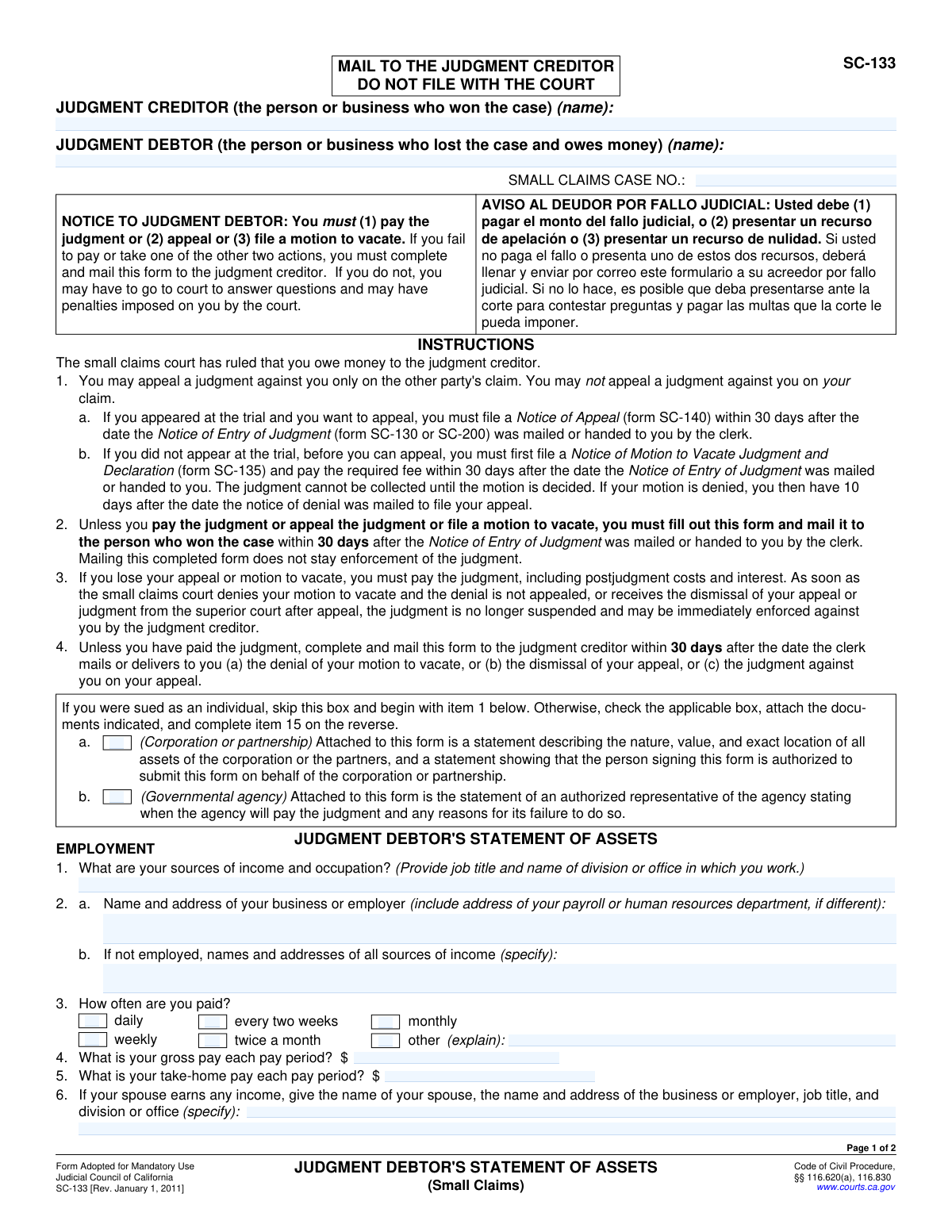
Yes! You can use AI to fill out Form SC-133, Judgment Debtor's Statement of Assets (Small Claims)
The Judgment Debtor's Statement of Assets (SC-133) is a mandatory form in California for individuals who have lost a small claims case and have not paid the judgment. It requires the debtor to provide a detailed list of their income, bank accounts, property, and other assets to the person who won the case (the judgment creditor). This disclosure helps the creditor in their efforts to collect the money owed. Today, this form can be filled out quickly and accurately using AI-powered services like Instafill.ai, which can also convert non-fillable PDF versions into interactive fillable forms.
SC-133 is part of the
California court forms, California state forms, court claim forms and small claims forms categories on Instafill.
Our AI automatically handles information lookup, data retrieval, formatting, and form filling.
It takes less than a minute to fill out SC-133 using our AI form filling.
Securely upload your data. Information is encrypted in transit and deleted immediately after the form is filled out.
Form specifications
| Form name: | Form SC-133, Judgment Debtor's Statement of Assets (Small Claims) |
| Number of fields: | 81 |
| Number of pages: | 1 |
| Language: | English |
Instafill Demo: How to fill out PDF forms in seconds with AI
How to Fill Out SC-133 Online for Free in 2026
Are you looking to fill out a SC-133 form online quickly and accurately? Instafill.ai offers the #1 AI-powered PDF filling software of 2026, allowing you to complete your SC-133 form in just 37 seconds or less.
Follow these steps to fill out your SC-133 form online using Instafill.ai:
- 1 Navigate to Instafill.ai and upload or select the SC-133 form.
- 2 Use the AI assistant to input the names of the Judgment Creditor and Judgment Debtor, along with the Small Claims Case Number.
- 3 Provide detailed information about your employment and all sources of income, including pay frequency and amounts.
- 4 List all cash on hand and money held in financial institutions like banks and credit unions, specifying account details and balances.
- 5 Disclose all owned property, including vehicles, boats, and real estate, detailing their value and any outstanding loans against them.
- 6 List any other valuable personal property and answer questions regarding recent asset transfers.
- 7 Review all entered information for accuracy, then digitally sign and date the declaration before mailing the completed form to the judgment creditor.
Our AI-powered system ensures each field is filled out correctly, reducing errors and saving you time.
Why Choose Instafill.ai for Your Fillable SC-133 Form?
Speed
Complete your SC-133 in as little as 37 seconds.
Up-to-Date
Always use the latest 2026 SC-133 form version.
Cost-effective
No need to hire expensive lawyers.
Accuracy
Our AI performs 10 compliance checks to ensure your form is error-free.
Security
Your personal information is protected with bank-level encryption.
Frequently Asked Questions About Form SC-133
This form is used by a person who lost a small claims case (the judgment debtor) to list their income, money, and property for the person who won (the judgment creditor). It provides the creditor with information to help them collect the money they are owed.
You must fill out this form if you are the judgment debtor and you have not paid the judgment, filed an appeal, or filed a motion to vacate the judgment within the specified timeframe.
You must complete and mail this form to the judgment creditor within 30 days after the date the 'Notice of Entry of Judgment' (Form SC-130 or SC-200) was mailed or handed to you.
You must mail the completed form directly to the judgment creditor at the address shown on the 'Notice of Entry of Judgment' form. Do not file this form with the court.
If you fail to complete and mail this form as required, you may have to go to court to answer questions about your finances and could have penalties imposed on you by the court.
You must disclose your sources of income, employment details, cash, bank accounts, vehicles, real estate, and any other valuable personal property. You do not need to list general household furniture, appliances, or clothing.
You can use section 14 to propose a monthly payment plan to the judgment creditor. If you cannot reach an agreement, you can file a 'Request to Make Payments' (Form SC-220) with the court to ask for an installment plan.
Yes, section 6 of the form requires you to provide the name and employment information of your spouse if they earn any income.
No, mailing this form does not stop the judgment creditor from taking legal action to enforce the judgment and collect the money you owe.
If you are a corporation or partnership, check the appropriate box near the top of the form and attach a statement describing the business's assets. You do not need to fill out the personal asset sections for individuals.
Yes, services like Instafill.ai use AI to accurately auto-fill form fields with your information, which can save you time and help prevent mistakes.
You can use a service like Instafill.ai to complete the form online. Simply upload the PDF, and the platform will make it an interactive form that you can type your information into directly.
If you have a non-fillable or 'flat' PDF, you can upload it to Instafill.ai. The service can convert the document into an interactive, fillable form for you to complete on your computer.
Compliance SC-133
Validation Checks by Instafill.ai
1
Gross Pay Exceeds Take-Home Pay
This validation ensures that the value entered for 'take-home pay' (item 5) is not greater than the value for 'gross pay' (item 4). Gross pay is the total earnings before any deductions, while take-home pay is the amount after deductions. It is logically impossible for take-home pay to be more than gross pay, so this check prevents data entry errors. If this validation fails, the user should be prompted to correct the pay amounts.
2
Conditional Requirement for 'Other' Pay Frequency
This check verifies that if the 'other' checkbox is selected for pay frequency (item 3), the corresponding explanation text field is not empty. The form requires an explanation for any pay frequency that does not fit the standard options. This ensures complete and understandable information is provided to the judgment creditor. A failure would require the user to either provide an explanation or select a different frequency.
3
Conditional Disclosure for Held Assets
This validation rule checks that if the 'Yes' box is checked for item 12 ('Is anyone holding assets for you?'), the subsequent text field describing the assets and holder is filled in. This is a critical disclosure for asset discovery, and leaving the details blank after indicating 'Yes' would make the form incomplete. If the check fails, the system should prompt the user to provide the required details or change the answer to 'No'.
4
Conditional Disclosure for Transferred Assets
This rule validates that if the 'Yes' box is checked for item 13 ('Have you disposed of or transferred any asset within the last 60 days?'), the corresponding details field is completed. This information is crucial for the creditor to identify potentially fraudulent transfers intended to hide assets. Answering 'Yes' without providing specifics defeats the purpose of the question. The user must provide details or correct the answer to 'No'.
5
Payment Proposal Completeness
This check ensures that if a monthly payment amount is offered in item 14, a corresponding start date is also provided, and vice versa. An offer to pay is incomplete without a specified start date, and a date is meaningless without an amount. This validation ensures a complete and actionable payment proposal is made. If one field is filled, the other must also be completed.
6
Future Payment Start Date
This validation confirms that the payment start date provided in item 14 is a future date. A payment plan, by its nature, begins on a future date, not one that has already passed. This check prevents nonsensical or invalid data entry. If the date entered is in the past or today, the user should be prompted to enter a valid future date.
7
Signature Date Presence and Format
This check verifies that the 'Date' field in the signature section (item 15) is filled out with a valid, correctly formatted date. The date of signature is legally significant as it attests that the information was true and correct on that specific day. An empty or improperly formatted date field would invalidate the declaration, so the form cannot be submitted without it.
8
Printed Name Matches Judgment Debtor
This validation compares the 'TYPE OR PRINT NAME' field in the signature section (item 15) with the 'JUDGMENT DEBTOR' name at the top of the form. The person signing the declaration of assets must be the same person who owes the debt. This check prevents an unauthorized individual from completing the form and ensures legal accountability. A mismatch should trigger a warning and require correction.
9
Case Number Presence
This check ensures the 'SMALL CLAIMS CASE NO.' field is not empty. The case number is the primary identifier that links this asset statement to the specific court judgment. Without it, the document has no context and cannot be properly associated with the legal case by the judgment creditor. Submission should be blocked until a case number is provided.
10
Income Source Completeness
This validation ensures that if the debtor is employed or has income, at least one of the income source fields (item 1a or 1b) is completed. The primary purpose of the form is to identify assets and income for judgment collection. Failing to provide any income information, if it exists, makes the form incomplete. The system should prompt the user to fill in either their employer information or other sources of income.
11
Vehicle Identification Number (VIN) Format
This check validates that any entry in the 'License and vehicle identification (VIN) numbers' column (item 9) adheres to the standard 17-character alphanumeric format for modern VINs. A valid VIN is crucial for accurately identifying a vehicle asset for potential seizure or lien. An invalid format suggests a typo or incorrect information, and the user should be prompted to review and correct the entry.
12
Bank Account Row Completeness
This validation ensures that for each row in the bank accounts section (item 8), if a 'Name and address of financial institution' is provided, a corresponding 'Balance' must also be entered. Listing a bank without its balance provides incomplete information for asset recovery. This check enforces the provision of a complete financial picture for each listed account.
13
Monetary Field Validation
This is a general check applied to all fields expecting a dollar amount (e.g., items 4, 5, 7, 8, 9, 10, 11, 14). It verifies that the input is a valid non-negative number, formatted as currency (e.g., allows digits, a single decimal point, and commas). This prevents entry of text or invalid characters into financial fields, ensuring data integrity for all asset values and pay amounts.
14
Declaration and Signature Fields Completion
This check ensures that the 'SIGNATURE' and 'TYPE OR PRINT NAME' fields (item 15) are both completed before submission. The declaration under penalty of perjury is the most critical legal component of the form, and it is invalid without a signature and a clearly identified signer. This validation prevents the submission of an legally unenforceable document.
Common Mistakes in Completing SC-133
The form explicitly states 'DO NOT FILE WITH THE COURT' and 'MAIL TO THE JUDGMENT CREDITOR'. Many people mistakenly file it with the court clerk out of habit. This is a critical error because the judgment creditor will not receive the required financial information, and the debtor will not have fulfilled their legal obligation, potentially leading to court sanctions for non-compliance.
Mistyping the Small Claims Case Number or misspelling the names of the Judgment Creditor or Judgment Debtor is a frequent error. This often happens when transcribing information from the 'Notice of Entry of Judgment'. An incorrect case number can lead to the document being associated with the wrong file or being rejected, causing significant delays and preventing the debtor from complying with the court's order in a timely manner.
Debtors often list their employer's main address but fail to provide the specific address for the payroll or human resources department as requested in Item 1a. This omission significantly hinders the creditor's ability to serve a wage garnishment order, as legal notices must be sent to the correct department. To avoid this, check a recent pay stub or contact HR for the precise address for legal correspondence.
In Items 4 and 5, individuals frequently confuse 'gross pay' (total earnings before any deductions) with 'take-home pay' (net pay after taxes and deductions) or list the same number for both. This mistake, often due to rushing or not consulting a pay stub, provides an inaccurate financial picture. It can be viewed as misleading and may complicate negotiations for a payment plan.
When listing bank accounts in Item 8, debtors sometimes only list accounts solely in their name, forgetting or intentionally omitting accounts held jointly with a spouse or another person. The form requires disclosure of all accounts, 'either in your own name or jointly'. Failure to disclose joint accounts is a form of misrepresentation under penalty of perjury and can lead to serious legal consequences if discovered.
In Item 9, which asks for vehicle information, people often provide only the make, model, and license plate number, but omit the Vehicle Identification Number (VIN). The license plate can change, but the VIN is a unique, permanent identifier for the vehicle. Creditors need the VIN to place a lien on the vehicle, so omitting it makes it difficult for them to enforce the judgment against that asset.
In the property sections (Items 9, 10, and 11), there is a strong temptation to undervalue assets or 'forget' to list valuable items to protect them from seizure. This is a serious mistake, as the form is signed under penalty of perjury. Intentionally providing false information can lead to criminal charges and will destroy the debtor's credibility with the creditor and the court.
Item 13 asks if the debtor has transferred any assets in the last 60 days. Debtors may answer 'No' after having given money or property to a friend or relative to shield it from collection. This is considered a fraudulent transfer and can have severe consequences, including the court voiding the transfer and imposing additional penalties on the debtor for attempting to defraud a creditor.
Many debtors leave Item 14, the payment proposal section, blank. This is a missed opportunity to proactively suggest a manageable monthly payment plan. By not making a good-faith offer, the debtor appears uncooperative, prompting the creditor to pursue more aggressive collection methods like bank levies or wage garnishments immediately, rather than considering a payment arrangement.
An unsigned or undated form is legally invalid. This simple oversight, usually happening in a rush, means the debtor has not officially complied with the order to provide a statement of assets. The creditor will reject the form, and the debtor may face penalties for failing to meet the 30-day deadline. AI-powered tools like Instafill.ai can help prevent this by flagging missing signature and date fields before finalization. If the form is a non-fillable PDF, Instafill.ai can also convert it into an interactive, fillable version to streamline the process.
Saved over 80 hours a year
“I was never sure if my IRS forms like W-9 were filled correctly. Now, I can complete the forms accurately without any external help.”
Kevin Martin Green
Your data stays secure with advanced protection from Instafill and our subprocessors

Robust compliance program
Transparent business model
You’re not the product. You always know where your data is and what it is processed for.
ISO 27001, HIPAA, and GDPR
Our subprocesses adhere to multiple compliance standards, including but not limited to ISO 27001, HIPAA, and GDPR.
Security & privacy by design
We consider security and privacy from the initial design phase of any new service or functionality. It’s not an afterthought, it’s built-in, including support for two-factor authentication (2FA) to further protect your account.
Fill out SC-133 with Instafill.ai
Worried about filling PDFs wrong? Instafill securely fills form-sc-133-judgment-debtors-statement-of-assets-small-claims forms, ensuring each field is accurate.