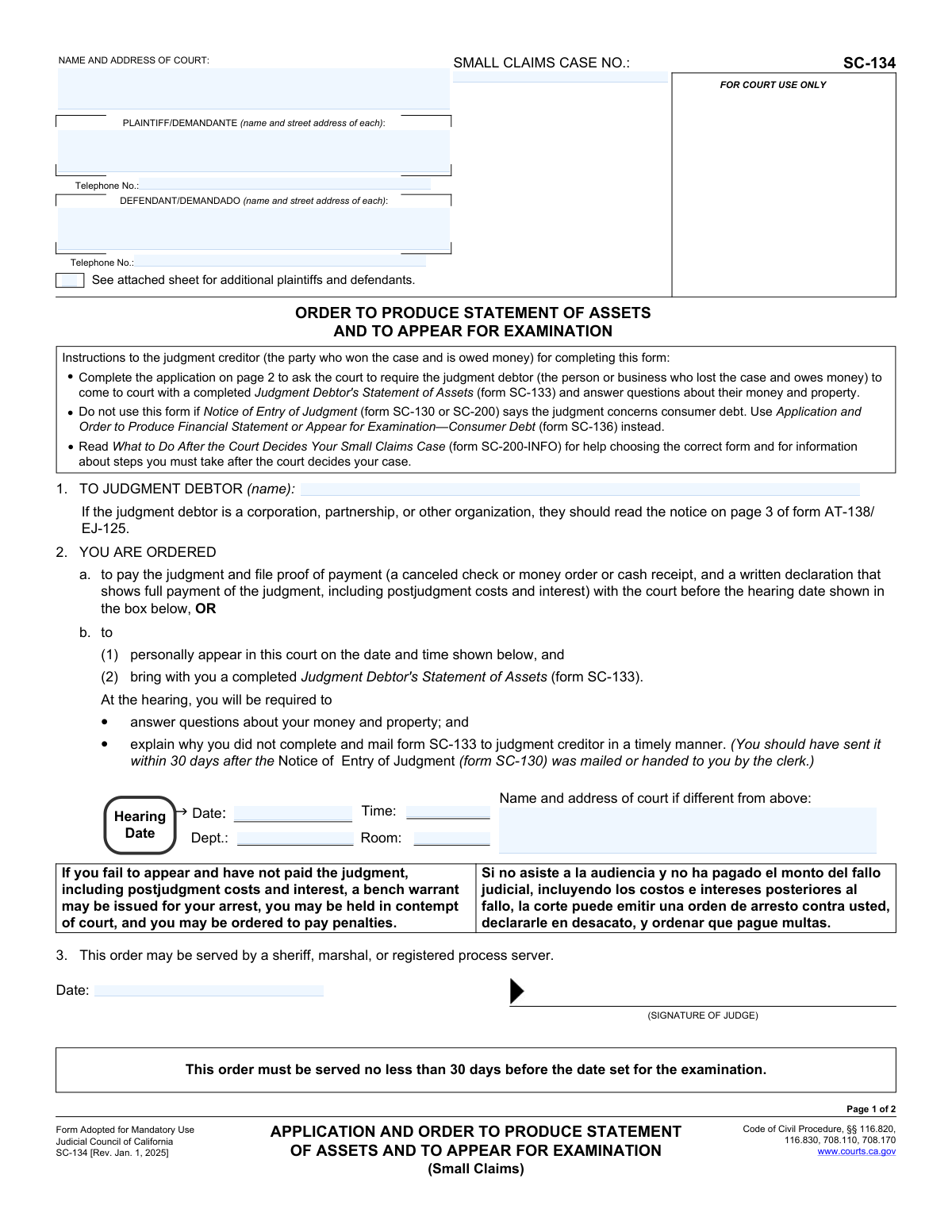
Yes! You can use AI to fill out Form SC-134, Application and Order to Produce Statement of Assets and to Appear For Examination
Form SC-134 is a legal document used in California small claims court by a judgment creditor (the person who won the case) to enforce a judgment. It requests a court order compelling the judgment debtor (the person who owes money) to appear for an examination and produce a completed Statement of Assets (Form SC-133). This process is essential for discovering the debtor's financial information to collect the owed money. Today, this form can be filled out quickly and accurately using AI-powered services like Instafill.ai, which can also convert non-fillable PDF versions into interactive fillable forms.
SC-134 is part of the
California court forms, California state forms, court claim forms and small claims forms categories on Instafill.
Our AI automatically handles information lookup, data retrieval, formatting, and form filling.
It takes less than a minute to fill out SC-134 using our AI form filling.
Securely upload your data. Information is encrypted in transit and deleted immediately after the form is filled out.
Form specifications
| Form name: | Form SC-134, Application and Order to Produce Statement of Assets and to Appear For Examination |
| Number of fields: | 26 |
| Number of pages: | 1 |
| Language: | English |
Instafill Demo: How to fill out PDF forms in seconds with AI
How to Fill Out SC-134 Online for Free in 2026
Are you looking to fill out a SC-134 form online quickly and accurately? Instafill.ai offers the #1 AI-powered PDF filling software of 2026, allowing you to complete your SC-134 form in just 37 seconds or less.
Follow these steps to fill out your SC-134 form online using Instafill.ai:
- 1 Navigate to Instafill.ai and upload or select Form SC-134, Application and Order to Produce Statement of Assets and to Appear For Examination.
- 2 Provide the court information, including the court name, address, and the small claims case number.
- 3 Enter the full names, addresses, and telephone numbers for both the plaintiff (judgment creditor) and the defendant (judgment debtor).
- 4 Complete the 'Application for this Order' section on page 2, confirming your identity as the judgment creditor and specifying the judgment debtor.
- 5 Verify the statements in item 5, such as non-payment of the judgment and not receiving the debtor's Statement of Assets.
- 6 Review all the information populated by the AI for accuracy, then download and print the completed form.
- 7 Sign and date the application, then follow the court's instructions for filing, paying fees, and serving the order on the judgment debtor.
Our AI-powered system ensures each field is filled out correctly, reducing errors and saving you time.
Why Choose Instafill.ai for Your Fillable SC-134 Form?
Speed
Complete your SC-134 in as little as 37 seconds.
Up-to-Date
Always use the latest 2026 SC-134 form version.
Cost-effective
No need to hire expensive lawyers.
Accuracy
Our AI performs 10 compliance checks to ensure your form is error-free.
Security
Your personal information is protected with bank-level encryption.
Frequently Asked Questions About Form SC-134
This form is used by a person who won a small claims case (the judgment creditor) to ask the court to order the person who owes money (the judgment debtor) to either pay the judgment or appear in court with a statement of their assets.
The judgment creditor, who is the person or business that won the small claims case and is owed money, must fill out the application portion of this form on page 2.
You can file this form if more than 30 days have passed since the Notice of Entry of Judgment was issued, the debtor has not paid, and you have not received their completed Judgment Debtor's Statement of Assets (form SC-133).
You should not use this form for consumer debt. The form specifies that you must use Form SC-136, Application and Order to Produce Financial Statement or Appear for Examination—Consumer Debt, instead.
You must contact the court clerk to get a hearing date, file the original completed form with the court, pay the filing fee, and then have the form legally served on the judgment debtor.
The form must be personally served on the judgment debtor by a sheriff, marshal, or registered process server at least 30 calendar days before the scheduled hearing date.
If the judgment debtor fails to appear at the hearing, the court may issue a bench warrant for their arrest, hold them in contempt of court, and order them to pay penalties.
Yes, you must attend the hearing unless the judgment has been paid in full before the court date. You should bring a copy of your completed Form SC-134 with you.
If you only want to request a court examination without demanding the Statement of Assets, you should use Form EJ-125, Application and Order for Appearance and Examination.
You need to provide your name and the debtor's name, and declare under penalty of perjury that the judgment has not been paid and you have not received the debtor's asset statement (Form SC-133).
Yes, services like Instafill.ai use AI to accurately auto-fill form fields with your case and personal information, which can save you time and help prevent errors.
You can use a service like Instafill.ai to easily fill out Form SC-134 online. The platform allows you to enter your information once and it will populate the correct fields throughout the document.
If you have a non-fillable or 'flat' PDF, you can use a tool like Instafill.ai to convert it into an interactive, fillable form that you can easily complete on your computer.
Compliance SC-134
Validation Checks by Instafill.ai
1
Case Number Presence and Format
This check verifies that the 'SMALL CLAIMS CASE NO.' field is not empty and conforms to the standard format for California court case numbers. The case number is the primary identifier linking this application to the original judgment, and its absence or incorrect format would make it impossible for the court clerk to file the document correctly. If this validation fails, the user should be prompted to enter a valid case number before submission.
2
Mandatory Court Name and Address
Validates that the 'NAME AND ADDRESS OF COURT' field is filled. This information is legally required to identify the jurisdiction and venue where the application is being filed and where the hearing will take place. A missing court address would render the form legally invalid and un-processable, so submission should be blocked until the field is completed.
3
Plaintiff/Creditor Information Completeness
Ensures that the plaintiff's name and street address fields are not empty. This information is crucial for identifying the party filing the application (the judgment creditor). Without this, the court cannot verify the applicant's standing or communicate with them, leading to immediate rejection of the form.
4
Defendant/Debtor Information Completeness
This check confirms that the defendant's name and street address fields are populated. Identifying the judgment debtor is the entire purpose of the order, as it specifies who must appear in court. An omission here would make the order unenforceable and legally meaningless.
5
Logical Hearing Date
Verifies that the 'Hearing Date' is a valid date set in the future. The form states the order must be served at least 30 days before the examination, so this check should flag any date in the past or within the next 30 days. An invalid hearing date would make the order defective and could lead to the hearing being canceled or the application being rejected.
6
Valid Hearing Time Format
Ensures the 'Time' field for the hearing is entered in a recognizable time format (e.g., HH:MM AM/PM). Ambiguity in the hearing time could be grounds for the judgment debtor to claim they were improperly notified, potentially invalidating the hearing. The system should enforce a standard format to prevent confusion.
7
Judgment Creditor Name Consistency
This validation compares the 'PLAINTIFF' name on page 1 with the 'Judgment creditor' name in item 4 on page 2. These names should refer to the same party and must be consistent for the application to be coherent. A mismatch could indicate a user error and cause confusion or legal challenges, so a warning should be displayed if the names do not match.
8
Judgment Debtor Name Consistency
Cross-references the 'DEFENDANT' name on page 1 with the 'JUDGMENT DEBTOR' name in item 1 and item 4. All three fields must contain the same name to ensure the order is directed at the correct individual or entity. A discrepancy would create a critical legal flaw, making the order potentially unenforceable against the intended party.
9
Declaration Date Validity
Checks that the 'Date' next to the declarant's signature on page 2 is a valid date that is not in the future. A declaration signed with a future date is legally invalid. This check prevents the submission of a perjurious or defective declaration, which would nullify the application.
10
Declarant Name Presence
Verifies that the 'TYPE OR PRINT NAME' field under the declaration in item 6 is not empty. This field identifies the person making the statements under penalty of perjury. An anonymous declaration has no legal weight, so the form cannot be processed without this information.
11
Valid Plaintiff Phone Number Format
This check validates that the 'Telephone No.' provided for the plaintiff is in a plausible format (e.g., 10 digits with optional formatting). While not always strictly mandatory for filing, it is the primary contact method for the court. An invalid number hinders communication, so the system should flag formats that are clearly incorrect.
12
Application Party Identification
Ensures that the names of the judgment creditor and judgment debtor are filled in item 4 on page 2. This section is the core of the application, explicitly stating who is applying for the order and against whom it is sought. Failure to complete this section would mean the application itself is incomplete and has no legal effect.
Common Mistakes in Completing SC-134
The form instructions explicitly state not to use SC-134 if the judgment concerns consumer debt, for which form SC-136 is required. Applicants often overlook this critical detail, leading to the court rejecting the application and forcing them to restart the process with the correct form. This mistake wastes both time and the filing fee. Always review the original judgment to confirm whether it is for consumer debt before proceeding.
Item 5.d requires the applicant to declare that more than 30 days have passed since the Notice of Entry of Judgment was served. In an effort to collect quickly, a judgment creditor might file before this waiting period has expired. This will result in the court clerk rejecting the application, as the debtor must be given the initial 30-day window to pay voluntarily. Carefully track the date of judgment and file only after the required period has passed.
A frequent and critical error is improper service of the court order. The instructions mandate personal service by a sheriff, marshal, or registered process server at least 30 days before the hearing. Mailing the form yourself or having a friend serve it is invalid and means the court cannot enforce the order or issue a warrant if the debtor fails to appear, rendering the entire effort and expense useless.
The order compels the debtor to appear with a completed Judgment Debtor's Statement of Assets (form SC-133). However, Instruction #4 on page 2 requires that a blank copy of SC-133 be served along with the SC-134. Creditors often forget to include this separate form, which undermines the order and gives the debtor a valid excuse for not having the statement prepared for the hearing.
The form uses the terms 'Plaintiff/Creditor' and 'Defendant/Debtor' interchangeably, which can cause confusion. A common mistake is entering the wrong party's name in a field, especially in Section 4. This can lead to the order being issued against the wrong person or being declared invalid by the court, causing significant delays. Double-check that the 'Judgment Creditor' is the person owed money and the 'Judgment Debtor' is the person who owes it.
Applicants sometimes fill out the form and submit it, leaving the 'Hearing Date' box on page 1 blank, assuming the court will assign one. However, the instructions require the applicant to contact the court clerk to schedule the hearing *before* filing. Submitting the form without a pre-scheduled date, time, and department will result in its rejection, as there is no event for the court to order.
The Small Claims Case Number is the essential link between this application and the original judgment. Forgetting to enter the number or transcribing it incorrectly is a simple but common error. Without the correct case number, the clerk cannot locate the file to process the application, leading to rejection or significant delays. This information should be copied exactly from the Notice of Entry of Judgment.
Item 5.f requires the creditor to confirm the debtor resides or has a business within the county or 150 miles of the court. Creditors may assume the debtor's address is current, but if they have moved outside this jurisdictional limit, the court cannot compel their appearance. Filing without verifying the debtor's location can result in a wasted filing fee and a hearing the debtor is not legally required to attend.
The application on page 2 is a declaration made under penalty of perjury and is invalid without a signature and date. It is a frequent oversight for applicants to leave the signature line or date field blank. An unsigned application will be immediately rejected by the court, halting the collection process. AI-powered form filling tools like Instafill.ai can help prevent this by flagging mandatory fields before submission.
This form's primary purpose is to enforce the debtor's obligation to provide a Statement of Assets (SC-133). If a creditor has already examined the debtor or only wants to conduct an examination without demanding the asset statement, they should use form EJ-125. Using SC-134 for a second examination or when the SC-133 is not the goal can lead to procedural issues or rejection by the court.
Saved over 80 hours a year
“I was never sure if my IRS forms like W-9 were filled correctly. Now, I can complete the forms accurately without any external help.”
Kevin Martin Green
Your data stays secure with advanced protection from Instafill and our subprocessors

Robust compliance program
Transparent business model
You’re not the product. You always know where your data is and what it is processed for.
ISO 27001, HIPAA, and GDPR
Our subprocesses adhere to multiple compliance standards, including but not limited to ISO 27001, HIPAA, and GDPR.
Security & privacy by design
We consider security and privacy from the initial design phase of any new service or functionality. It’s not an afterthought, it’s built-in, including support for two-factor authentication (2FA) to further protect your account.
Fill out SC-134 with Instafill.ai
Worried about filling PDFs wrong? Instafill securely fills form-sc-134-application-and-order-to-produce-statement-of-assets-and-to-appear-for-examination forms, ensuring each field is accurate.