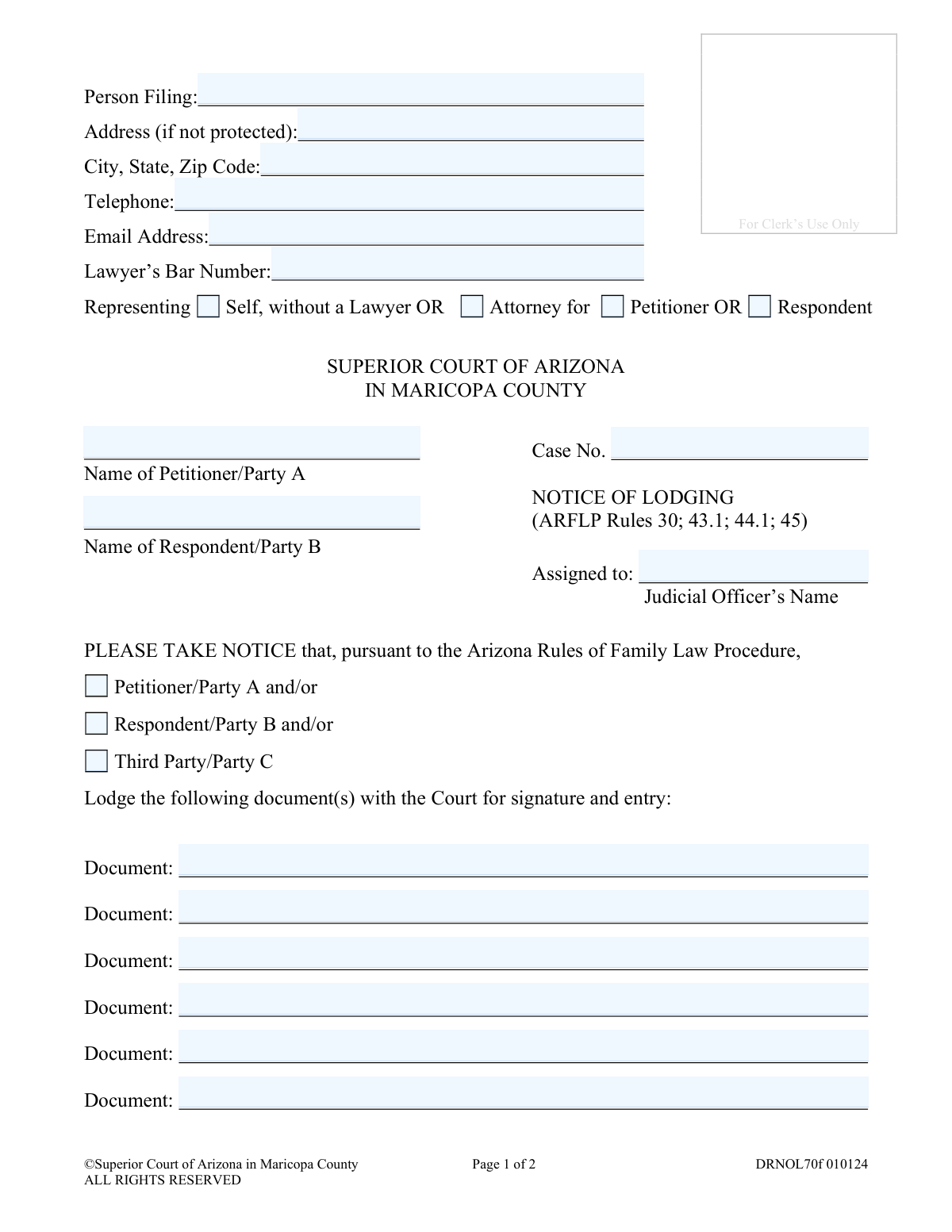
Yes! You can use AI to fill out Notice of Lodging (ARFLP Rules 30; 43.1; 44.1; 45)
The Notice of Lodging, form DRNOL70f, is a formal document filed with the Superior Court of Arizona in Maricopa County during family law proceedings. Its purpose is to officially notify the court that one or more parties are submitting ('lodging') other documents, such as proposed orders or decrees, for the assigned judicial officer's review and signature. This procedure ensures all parties are aware of the documents being presented to the judge for action. Today, this form can be filled out quickly and accurately using AI-powered services like Instafill.ai, which can also convert non-fillable PDF versions into interactive fillable forms.
DRNOL70f is part of the
County court forms, family court forms, family law forms and superior court forms categories on Instafill.
Our AI automatically handles information lookup, data retrieval, formatting, and form filling.
It takes less than a minute to fill out DRNOL70f using our AI form filling.
Securely upload your data. Information is encrypted in transit and deleted immediately after the form is filled out.
Form specifications
| Form name: | Notice of Lodging (ARFLP Rules 30; 43.1; 44.1; 45) |
| Number of fields: | 31 |
| Number of pages: | 1 |
| Language: | English |
Instafill Demo: How to fill out PDF forms in seconds with AI
How to Fill Out DRNOL70f Online for Free in 2026
Are you looking to fill out a DRNOL70F form online quickly and accurately? Instafill.ai offers the #1 AI-powered PDF filling software of 2026, allowing you to complete your DRNOL70F form in just 37 seconds or less.
Follow these steps to fill out your DRNOL70F form online using Instafill.ai:
- 1 Navigate to Instafill.ai and upload or select the Arizona Notice of Lodging form (DRNOL70f).
- 2 Enter your personal details in the top section, including your name, address, contact information, and representation status.
- 3 Input the specific case information, such as the Case Number, the names of the Petitioner and Respondent, and the assigned Judicial Officer.
- 4 Clearly indicate which party is lodging the documents by checking the appropriate box for Petitioner, Respondent, or a Third Party.
- 5 List each individual document you are lodging with the court in the provided fields.
- 6 Use the AI-powered review feature to check all entered information for accuracy and completeness before finalizing.
- 7 Sign and date the form, then download the completed document for filing with the Superior Court of Arizona in Maricopa County.
Our AI-powered system ensures each field is filled out correctly, reducing errors and saving you time.
Why Choose Instafill.ai for Your Fillable DRNOL70f Form?
Speed
Complete your DRNOL70f in as little as 37 seconds.
Up-to-Date
Always use the latest 2026 DRNOL70f form version.
Cost-effective
No need to hire expensive lawyers.
Accuracy
Our AI performs 10 compliance checks to ensure your form is error-free.
Security
Your personal information is protected with bank-level encryption.
Frequently Asked Questions About Form DRNOL70f
This form is used to officially notify the court and all parties in a family law case that you are submitting, or 'lodging,' specific documents for the judge's review and signature.
Any party (Petitioner, Respondent, or a Third Party) in a Maricopa County family law case who is submitting proposed orders, decrees, or other documents for the judge to sign must file this notice.
Lodging means submitting a document, like a proposed order, to the court for the judge's consideration and potential signature. It is not officially part of the case record until the judge signs and enters it.
You will need your case number, the names of the Petitioner and Respondent, the assigned Judicial Officer's name, and a list of the exact titles of the documents you are lodging.
In the 'Document' fields, you must list the full, exact titles of each document you are submitting for the judge's signature, such as 'Proposed Consent Decree of Dissolution of Marriage'.
Not always. While signature lines are provided for both parties, often only the party lodging the documents signs. If the lodged documents are by agreement, it is good practice for both parties to sign.
The name of the assigned judge or commissioner can be found on previous court documents filed in your case or by looking up your case on the Maricopa County Superior Court's public access website.
You must file the 'Notice of Lodging' with the Clerk of the Court and provide copies to the other party and the assigned judge, along with the actual documents being lodged, following local court rules.
No, they are different. Lodging is submitting a proposed document for a judge's review, while filing is the official act of placing a document into the permanent court record by the Clerk of the Court.
Yes, services like Instafill.ai use AI to accurately auto-fill form fields with your case and personal information, which saves time and helps prevent errors.
Simply upload the 'Notice of Lodging' PDF to the Instafill.ai platform. The AI will make the form fillable online, allowing you to type your information directly into the fields before downloading the completed document.
If you have a non-fillable or 'flat' PDF, you can use a service like Instafill.ai. It can convert the PDF into an interactive, fillable form online so you can easily complete it on your computer.
Compliance DRNOL70f
Validation Checks by Instafill.ai
1
Case Number Format and Presence
This check ensures the 'Case No.' field is not empty and conforms to the specific format used by the Superior Court of Arizona in Maricopa County. The case number is the primary identifier for the legal proceeding, and an incorrect or missing number will prevent the document from being correctly filed and associated with the case record.
2
Filer Identification Completeness
Validates that the 'Person Filing' field contains a full name. The court must be able to identify the individual or entity submitting the document for accountability and contact purposes. Failure to provide this information would render the submission anonymous and invalid.
3
Representation Status Logic
This check enforces logical consistency in the representation section. If 'Attorney for' is selected, the 'Lawyer’s Bar Number' field becomes mandatory. Conversely, 'Self, without a Lawyer' and 'Attorney for' should be mutually exclusive choices to avoid ambiguity about legal representation.
4
Attorney Client Specification
Ensures that if 'Attorney for' is selected, one of the party roles ('Petitioner' or 'Respondent') is also selected. This is critical for clarifying which party the attorney is representing in this specific filing. Without this, the court would not know on whose behalf the attorney is acting.
5
Lawyer's Bar Number Format
Validates that the 'Lawyer’s Bar Number' field, when provided, matches the official format for Arizona State Bar numbers. This serves as a verification of the attorney's credentials and their authority to practice before the court. An invalid number could indicate an unauthorized filing.
6
Minimum Document Lodging Requirement
This validation confirms that at least one of the 'Document' fields has been filled out. The entire purpose of a 'Notice of Lodging' is to inform the court of documents being submitted for review or signature. A notice listing no documents is a null action and would be rejected.
7
Lodging Party Identification
Verifies that at least one of the checkboxes for the lodging party ('Petitioner/Party A', 'Respondent/Party B', or 'Third Party/Party C') is selected. The court needs to know which party is initiating the lodging action. Failure to specify the lodging party makes the notice incomplete.
8
Email Address Format Validation
Checks that the value entered in the 'Email Address' field is a structurally valid email address (e.g., '[email protected]'). As courts increasingly rely on electronic communication and service, a valid email is essential for timely and official correspondence. An invalid format would prevent communication.
9
Telephone Number Format
Ensures the 'Telephone' field contains a number that conforms to a standard US phone number format (e.g., 10 digits with optional formatting). This provides a direct and reliable method for the clerk or judicial staff to contact the filer with urgent questions. An invalid number hinders communication.
10
Case Party Name Completeness
This check validates that both the 'Name of Petitioner/Party A' and 'Name of Respondent/Party B' fields are filled in. These names are fundamental to identifying the case and ensuring the notice is applied to the correct parties. Missing party names would make the filing ambiguous and unprocessable.
11
Signature Date Validity
Validates that any 'Date' field associated with a signature is a valid calendar date and is not set in the future. The date of signature is legally significant, attesting to when the document was executed. An invalid or future date would call the document's authenticity and timing into question.
12
Case Number Consistency Across Pages
This check compares the 'Case No.' field on page 1 with the 'Case Number' field on page 2 to ensure they are identical. A mismatch could be a sign of a typo and lead to the document being misfiled or rejected. This consistency check prevents clerical errors during processing.
Common Mistakes in Completing DRNOL70f
The case number is the primary identifier for your filing. People often make typos, transpose digits, or omit critical prefixes (e.g., 'FC' for Family Court), causing the document to be rejected or filed in the wrong case. An error here can lead to significant delays and legal complications. Always double-check the case number against official court documents before submitting.
Filers often list documents with generic names like 'Agreement' or 'Order' instead of the full, formal title, such as 'Stipulated Order for Parenting Time'. This ambiguity forces the court clerk and judge to guess which document is being lodged, potentially leading to the wrong document being signed or the filing being rejected for clarification. To avoid this, use the complete and exact title as it appears on each document being lodged.
The form requires you to check a box indicating if you are representing yourself ('Self, without a Lawyer') or are an attorney for a party. A common mistake is checking the wrong box, multiple conflicting boxes, or forgetting to check one at all. This creates confusion about the filer's role and can cause processing delays while the clerk verifies the information.
The form clearly specifies 'Address (if not protected),' yet filers in sensitive family law cases may overlook this and enter an address that is legally protected. Disclosing this information can compromise personal safety and may violate a court order of protection. If your address is protected, you must leave this field blank and follow the court's specific procedures for protected filers.
The names for the Petitioner and Respondent must exactly match the full legal names used in all other official case filings. Using nicknames, initials, or any variation can create record-keeping inconsistencies and may lead to the document being rejected. To ensure your filing is accepted, always use the full legal names as established in the original petition.
This form includes a field for the case number at the top of the second page, which is easily overlooked. If the pages of the filing were to become separated, the second page would be unidentifiable without this crucial information. This simple omission can result in an incomplete filing that must be corrected and resubmitted, delaying the entire process.
A missing signature is one of the most common and critical errors, as it immediately invalidates the filing and leads to rejection. Forgetting to include the date of the signature can also cause procedural issues. This oversight requires the filer to correct and resubmit the document, which delays the judge's review and signature of the lodged documents.
The form requires the filer to check a box indicating whether the Petitioner, Respondent, or a Third Party is lodging the documents. People often forget to check any box or check the wrong one, creating confusion about the submission's origin. This can delay processing as the court needs to know which party is responsible for the filing.
This form is often distributed as a non-fillable PDF, leading people to print and fill it out by hand. Illegible handwriting for critical data like names, case numbers, or document titles can make the form impossible for the clerk to process accurately, frequently resulting in rejection. AI-powered tools like Instafill.ai can convert such PDFs into fillable versions, ensuring all entries are typed, clear, and legible.
The form asks for the name of the assigned Judicial Officer, which filers may not know, misspell, or leave blank. Failing to include the correct name can slow down the internal routing of the document to the correct judge's chambers, delaying review. Always check other case documents or the court's online portal for the correct spelling of the assigned judge's full name.
Saved over 80 hours a year
“I was never sure if my IRS forms like W-9 were filled correctly. Now, I can complete the forms accurately without any external help.”
Kevin Martin Green
Your data stays secure with advanced protection from Instafill and our subprocessors

Robust compliance program
Transparent business model
You’re not the product. You always know where your data is and what it is processed for.
ISO 27001, HIPAA, and GDPR
Our subprocesses adhere to multiple compliance standards, including but not limited to ISO 27001, HIPAA, and GDPR.
Security & privacy by design
We consider security and privacy from the initial design phase of any new service or functionality. It’s not an afterthought, it’s built-in, including support for two-factor authentication (2FA) to further protect your account.
Fill out DRNOL70f with Instafill.ai
Worried about filling PDFs wrong? Instafill securely fills notice-of-lodging-arflp-rules-30-431-441-45 forms, ensuring each field is accurate.